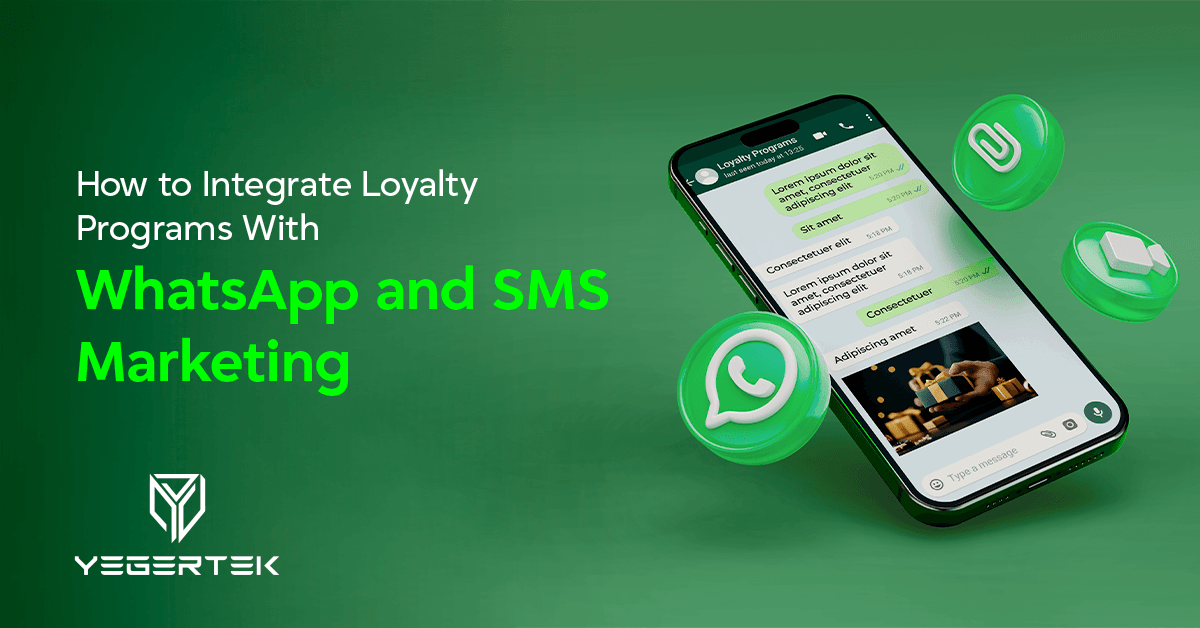
Loyalty programs are most effective when they reach customers where they already are. For most consumers across the Middle East as well as south Asia and beyond, that place is their messaging inbox. WhatsApp commands attention in a way that email never will, and SMS is the only channel that is guaranteed to get through to someone regardless of their level of smartphone sophistication or access to the internet.
Yet, many enterprises still treat messaging channels as afterthoughts into their loyalty architecture. Points balances get buried in apps that customers rarely open. Reward notifications fall into email drawers with the promotional noise. The outcome is a loyalty program that lives on paper but has a hard time creating the change in behavior that it was designed to cause.
Integration between loyalty platforms and messaging channels solves this disconnect. When done well, it converts loyalty from a passive accumulation activity to an active and conversational relationship between brand and customer.
Why Messaging Channels Outperform Traditional Loyalty Communication
Consider how people actually interact with their phones. For most retail communications, the email open rates are around 20 percent. SMS open rates are higher than 90 percent, and often within three minutes of delivery. WhatsApp sits somewhere in between but has richer interaction capabilities which email cannot match.
This attention differential is of enormous importance to loyalty programs. A member who never sees their points balance approaching a reward threshold cannot be motivated by it. A member who gets a timely WhatsApp message notifying them that they are 50 points away from a free product has a reason to make another purchase today.
The regional context makes this dynamic more evident. In the UAE and MENA in general, WhatsApp has become the communication channel of choice, for both personal and commercial communication. Customers expect brands to communicate through these channels because this is where their attention is naturally, anyway.
Technical Architecture for Messaging Integration
Successful integration is more than just connecting your loyalty platform to a messaging API. The architecture must be capable of supporting real-time triggering of events, personalization at scale and two-way interaction capabilities.
Event-Driven Communication
Your loyalty engine should send out messages when your customer performs specific actions or reaches certain milestones. A transaction which moves someone to a new tier should trigger an immediate congratulatory message. A point balance crossing a redemption threshold should require a notification within minutes, not hours.
This necessitates that your customer engagement and loyalty software have real-time connections with messaging gateways as opposed to batch processing. The latency difference between batch and real-time could be the difference between reaching a customer while they are still thinking about your brand and reaching them hours later when the ship has already sailed.
Personalization Infrastructure
Generic loyalty messages get ignored. Effective messaging requires integration with your customer data platform at the deepest levels so that each communication is in the context of the recipient. This means that they should know their name, their tier status, their recent transaction history, their preferred language, and their typical shopping patterns.
Platforms built on Microsoft Dynamics 365 have an advantage here because the CRM foundation offers a unified view of customers for messaging integrations to tap straight into. The other option – keeping separate customer databases for loyalty and messaging – leads to synchronization headaches and inevitably embarrassment in the form of communication gaps.
Conversational Capabilities
WhatsApp in particular supports interactive messaging which goes beyond simple notifications. Customers can determine their points balance by sending a message. They can view the available rewards and make the redemptions directly in the chat. They can ask questions about the rules of the programs and receive immediate responses.
Building these flows of conversation requires careful design. The chatbot needs to be able to grasp the variations of natural language and to be able to gracefully handle the request it cannot fulfill. It needs to keep the context throughout a conversation and not treat each message separately.
Strategic Use Cases That Produce Results
Integration opens up many tactical applications, but some tend to have better results than others.
Proximity-based redemption promotions are especially effective in retail and F&B. When a loyalty member walks into a store or walks close to a familiar location, a WhatsApp message that shows the member available rewards can turn a casual encounter into a purchase.
Expiration warnings are another high-value use case. Points that are about to expire create a sense of urgency but that is only if the customer is aware of that. An SMS seven days before expiration and then a reminder via WhatsApp at three days can save a lot of value that would otherwise evaporate.
Birthday and anniversary messages with attached bonus offers are usually consistently well received through messaging channels. The personal nature of these occasions is in sync with the intimate nature of a WhatsApp message in ways that email simply cannot replicate.
Implementation Considerations for Enterprise Teams
Before implementing messaging integrations, there are a number of operational considerations to note.
Opt in management is non-negotiable. Both WhatsApp and SMS require consent for marketing communications in most jurisdictions. Your loyalty enrollment flow must make clear what these permissions are, and must store them in ways that facilitate compliance auditing.
Message frequency needs to be carefully governed. The immediacy that makes messaging powerful can also produce fatigue if it is overused. Have clear rules in place around how many messages can be sent to any one customer in one week and make sure your loyalty platform automatically enforces these rules.
There is a great deal of regional compliance. What works in the UAE may need to be changed for Saudi Arabia or India. WhatsApp Business API has its own template approval process which can create delays. Plan for these variations in your timeline for implementation.
Measuring Integration Success
The measures that are important with messaging-integrated loyalty differ from traditional program KPIs. Beyond the usual delivery and open rates, monitor the conversion rate from message to action. How many customers who were sent a points balance notification made a purchase within 48 hours? How many of the expiration warnings resulted in redemptions?
Compare these figures to control groups who did not receive messaging communications. The incremental lift attributable to messaging is used for justification of continued investment and is used to guide optimization efforts.
Moving Forward
Integrating loyalty programs with WhatsApp and SMS is no longer a factor in competitive differentiation – it is an expectation. Customers who take part in loyalty schemes want to be aware of their status and opportunities in real-time. Messaging channels give that awareness like no other medium can.
The technical complexity is manageable with the right foundation of the platform. Solutions based on enterprise CRM infrastructure such as Microsoft Dynamics 365 bring a lot of the integration plumbing with it already established. The rest of the work is configuration, workflow creation, and intelligent thought content strategy!
For organizations that are still using email as the main channel of communication to their customers in the form of loyalty communication, the transition to messaging is one of the highest impact improvements available. The attention is there. The technology is mature. What is left is the decision to do.